First, to those who would say the Rule of Decent Behavior is more of a guideline than an actual rule, to borrow a piratical turn of phrase. These sociology professors would say that what Jack (Lewis, not Sparrow) means by the Moral Law is not all that different from the urge you and I have to eat when we're hungry or the feeling a mom gets when she holds her little baby. Jack points out though, that the Law of Human Nature is a level deeper than those desires. Take the example Lewis gives: suppose that you are walking through the subway tunnels in New York, trying to catch your train so you can get home after a long day at work. You hear a cry from
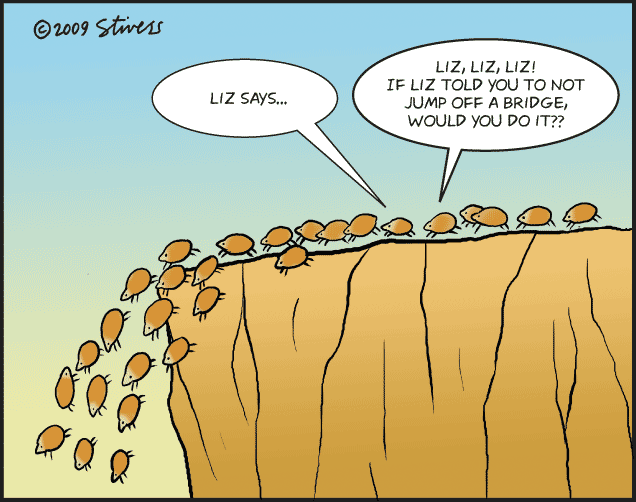 someone nearby asking for help. You might feel several (conflicting) instincts - the desire to help (herd instinct) or the desire to just ignore the guy and keep walking (self-preservation instinct). You might also be hungry, or tired, or late to meet your spouse for a play. Perhaps you dream of being a superhero and leap at the chance to rescue someone in need (if you laugh at that idea, you either lack a soul or you've never been young person with a dream of being a superhero someday. Either way, shame on you). Any number of "instincts" might be vying for your attention. However, surfing around on that sea of contradictory impulses is the feeling that we ought to follow one particular course of action. There is a "thing which tells you that you ought to follow the impulse to help, and suppress the impulse to run away" (10). Lewis remarks that the thing that tells you which instinct to follow cannot itself be an instinct. He continues by stating that our "instinct moderator" often seems to encourage us to follow the weaker of our urges; that is, most of us find ourselves fighting the self-preservation instinct by convincing ourselves that the right thing to do is to intervene. Surely this moderator cannot itself be just another instinct.
The thing that says to you, "Your herd instinct is asleep. Wake it up" cannot itself be the herd instinct. The thing that tells you which note on the piano needs to be played louder cannot itself be that note. (10)
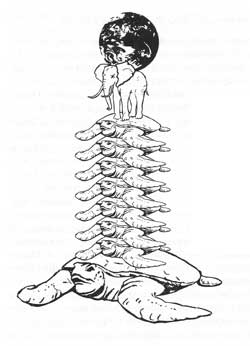
Lewis then turns to his second group of questioners, who would like to dismiss his arguments by saying that the Moral Law is merely a social convention. The implicit assumption here is that if you learned something from your parents or your teachers, then that thing must be "merely a human invention" (12). Lewis agrees that the Rule of Decent Behavior is something we are taught, but he disagrees that you can dismiss it on those grounds. Instead he points out that there are two kinds of truths: the kind that are just arbitrary rules and the kind that are real truths. In a touch of irony for the Americans out there, he points out an arbitrary rule, that "we learn to keep to the left of the road, but it might just as well have been the rule to keep to the right" (12). On the other hand, Lewis argues that Moral Law belongs in the same class as mathematics or physics or other real truths. He recalls his argument in the previous chapter that a
 study of history will reveal that most people believed remarkably similar things about morality, hinting that the Law is not simply arbitrary. He goes on to suggest that many of us believe in the idea of "moral progress." Comparing one set of moral rules to another and proclaiming it "better" implies that there is some root morality, some Real Truth that we should conform our morality to. And that in turn implies that the Moral Law is not a convenient structure that is useful because we agree to it, but that it really is a grand truth we ought to follow.
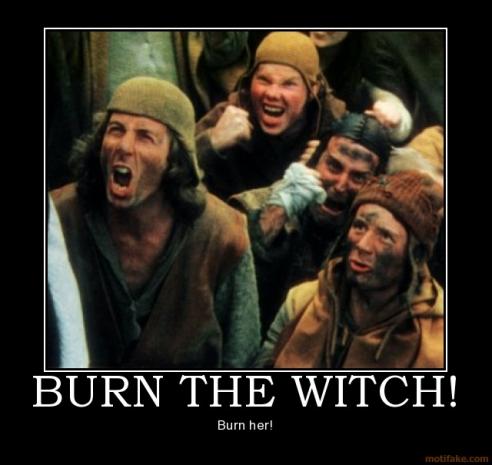
This chapter concludes with a short illustration by Lewis to those who would look at history and claim that they see very different Moral Laws at work, thus proving there is no one Law of Human Nature claiming our allegiance. Lewis uses the historical example of the burning of witches to prove his point. Some might say "Three hundred years ago people ... were putting witches to death. Was that what you call the Rule of Human Nature?" (14). Lewis's response follows here, and it would be good for us to take it to heart for those times when we meet skeptics who would claim the Moral Law is variable. Plus, it's super pithy and I can't resist a good quote.
Surely the reason we do not execute witches is that we do not believe there are such things. If we did-if we really thought that there were people going about who had sold themselves to the devil and were ... using [their] powers to kill their neighbors-surely we would all agree that if anyone deserved the death penalty, then these filthy quislings did? There is no difference of moral principle here: the difference is simply about matter of fact. It may be a great advance in knowledge not to believe in witches: there is no moral advance in not executing them when you do not think they are there. You would not call a man humane for ceasing to set mousetraps if he did so because he believed there were no mice in the house. (14-15)

Thanks!
ReplyDelete