Tuesday, January 29, 2013

Another Look at Our First Signpost

After his discursion into answering some objectors, Lewis begins Chapter 3 by referring us back to our topic from the first chapter: the Law of Human Nature. He delves into an extended comparison between what we think of as Laws of Nature (gravity, for example) and the Law of Human Nature.

Jack begins by noting what he terms an "odd" thing; men everywhere are "haunted by the idea of a sort of behavior they ought to practice" but "they [do] not in fact do so" (16). We'll jump ahead to his conclusion and come back to his illustrations in a moment. Lewis concludes by saying it is odd for man to feel bound to some set of rules that he doesn't actually bother keeping most of the time. I think I agree with Lewis; we seem to be at least partly broken creatures if we go around thinking that we ought to behave a certain way, when in fact we do not actually bother sticking to that way when it gets hard or uncomfortable. What is wrong with us? Let's return to Lewis's argument and see how he illustrates this problem. Pretend for a moment you have a tree growing in your front yard. It's a little frustrating for you, because it doesn't seem to have branched out as much as you wanted, so it's not giving as much shade as it should. Would you blame the tree for not being shady enough? You know the tree is just a product of the soil it grew in and the weather and care it received, and it could hardly have turned out differently. A similar tree in your neighbor's yard, however, is growing spectacularly well. It has big branches with lots of leaves and healthy looking bark. That tree is also a product of its environment. In that sense, both the "bad" and the "good" tree are obeying the Laws of Nature. But in what sense can we call them laws, then, if obeying the Laws of Nature can lead to such different results?

Put another way, what we call the Laws of Nature are not so much prescriptive as they are descriptive. That is, they don't so much dictate what should happen as they tell us what does happen. Drop a pebble, and it falls. Shoot one pool ball at another and the total momentum will be conserved. Electrons will always move from the negative terminal to the positive terminal. However, the pebble and the pool balls and the electrons aren't exactly choosing to obey their respective laws. When we talk about the Laws of Nature, we just mean "what Nature, in fact, does" (17). The Law of Human Nature is very different though. We have already seen that it is not descriptive (since humans tend to be pretty terrible at keeping the Laws) but prescriptive. While the law of gravity tells us that rocks fall when you drop them, the Moral Law tells the way people should act (but don't).

Someone who doesn't believe in moral absolutes might interject "Well, you're just phrasing things badly. When you notice that men don't act the way they 'should', you just mean they don't act in a way that is pleasing to you." Certainly that's what we mean when we call the sickly tree a "bad" tree, and the healthy one a "good" tree. It's not pleasing or convenient for me to have a tree that doesn't provide shade. However, this idea doesn't hold up too well when we apply it to people. Take for example a crowded parking lot. If someone cuts in front of me as I'm about to pull into a spot, I'm really tempted to start questioning the legitimacy of his parentage, not to mention the legitimacy of his driver's license. However, if I'm in a line waiting to park, and that same guy takes the last available spot, I don't get mad at him at all. Both cases are equally inconvenient, but only one of them raises my blood pressure. Or take Lewis's example: if someone trips you accidentally, you don't get angry at him (at least not once you realize it's an accident). But if someone tries to trip you and fails, you'd be entirely justified to be angry. In that case, the thing that you would call "bad" is the one that didn't actually inconvenience you. So, it won't work to say that decent behavior in others is just the behavior that happens to be convenient to us.

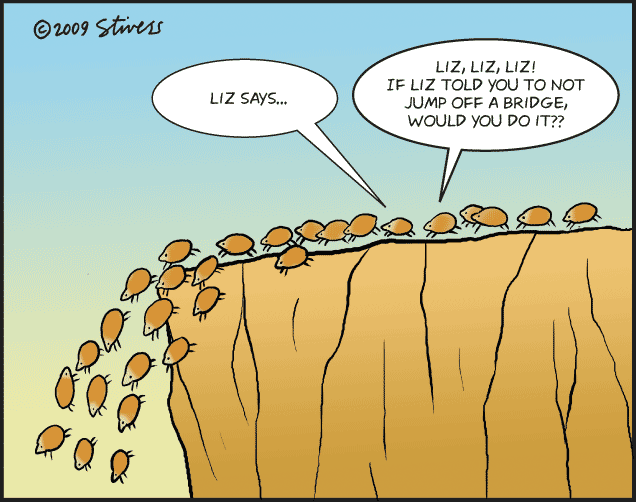
Our Unbeliever-in-Moral-Absolutes will consider this for a moment, and reply "Aha! Yes, I agree, when we say men should act a certain way, we don't just mean they should act in a way convenient to us. Rather, we mean that men should act a certain way because it's good for the human race as a whole." Our Unbeliever has a point; after all, society won't function well if we all act like jerks to each other. The problem with this train of thought is that it chases its own caboose. Let's imagine the conversation:
Lewis: So, you claim men should be kind to each other because it's good for society, right?
Unbeliever: Yes, that's exactly what I mean. Altruism is good for the survival of the group.
Lewis: Let me see if I understand...why should I act unselfishly?
Unbeliever: Because it's good for society.
Lewis: Ok. But...but why should I care about society except when it affects me
Unbeliever: Well, because that is best for the survival of the group.
Lewis: But that's the whole definition "unselfish"!
And Lewis is right. Being unselfish just means setting aside your wants and desires and doing what is better for others ("society"). Our Unbeliever is saying that the reason we should behave decently is to benefit society, but all that means is that "decent behavior is decent behavior. [He] would have said as much if [he] had stopped at the statement, 'Men ought to be unselfish' " (20).

Lewis stops the chapter at this point by concluding that the Law of Human Nature is not an observation about the way people do, in fact, behave. Nor is it a description of how we wish people would behave, since what we call "bad" behavior is not always what we find inconvenient but sometimes the exact opposite. Thus, the Law of Human Nature must be something outside us altogether, or as Lewis puts it "a real thing - a thing that is really there...a real law, which none of us made, but which we find pressing on us" (20). We are perilously close to having to admit that something or maybe even someone (we won't yet say it is a Someone) out there is dictating how we should behave. Lewis will explore this idea a little more in the next chapter and will attempt to prove that there really is a someone behind the Law of Human Nature.

Tuesday, January 22, 2013

A Brief Detour

It would appear that Lewis received a number of letters and questions from listeners who objected to his remarks about the "Law of Human Nature," because he dedicates a whole chapter to addressing this topic. If you remember from last week, Lewis was trying to say there is "a curious idea that [we] ought to behave in a certain way" (8) which he termed the Law of Human Nature, or the Moral Law. Lewis casts his objectors into one of two molds: the Law of Human Nature is just a herd instinct, or else it is just a social construct we teach our children. Notice that both objections make the Moral Law into nothing more than a tool: either something Nature blesses us with to help us thrive, or something our parents pound into us in an attempt to keep society functioning. What follows is a summary of Lewis's rejoinders to these two objections.

First, to those who would say the Rule of Decent Behavior is more of a guideline than an actual rule, to borrow a piratical turn of phrase. These sociology professors would say that what Jack (Lewis, not Sparrow) means by the Moral Law is not all that different from the urge you and I have to eat when we're hungry or the feeling a mom gets when she holds her little baby. Jack points out though, that the Law of Human Nature is a level deeper than those desires. Take the example Lewis gives: suppose that you are walking through the subway tunnels in New York, trying to catch your train so you can get home after a long day at work. You hear a cry from
someone nearby asking for help. You might feel several (conflicting) instincts - the desire to help (herd instinct) or the desire to just ignore the guy and keep walking (self-preservation instinct). You might also be hungry, or tired, or late to meet your spouse for a play. Perhaps you dream of being a superhero and leap at the chance to rescue someone in need (if you laugh at that idea, you either lack a soul or you've never been young person with a dream of being a superhero someday. Either way, shame on you). Any number of "instincts" might be vying for your attention. However, surfing around on that sea of contradictory impulses is the feeling that we ought to follow one particular course of action. There is a "thing which tells you that you ought to follow the impulse to help, and suppress the impulse to run away" (10). Lewis remarks that the thing that tells you which instinct to follow cannot itself be an instinct. He continues by stating that our "instinct moderator" often seems to encourage us to follow the weaker of our urges; that is, most of us find ourselves fighting the self-preservation instinct by convincing ourselves that the right thing to do is to intervene. Surely this moderator cannot itself be just another instinct.
The thing that says to you, "Your herd instinct is asleep. Wake it up" cannot itself be the herd instinct. The thing that tells you which note on the piano needs to be played louder cannot itself be that note. (10)
Lewis then attempts to express his point by approaching it by a different path. Suppose for a moment that we accept the proposition that what we would like to call the Law of Human Nature is just one of our instincts (and that the thing that chooses which instinct to follow is itself just another instinct), then surely we could point to one impulse or another and say that it was a good instinct or a bad instinct. For instance, isn't the love a mother has for her baby, or the stirrings of patriotism we all feel every time they sing the Star-Spangled Banner at a football game (see my comments earlier about superheros if you similarly lack a patriotic instinct) a good thing? But if we examine it a little closer, surely sometimes it is better to suppress patriotism so that we do not act immorally toward those who live in a different country. Certainly it also would not do for a mother to love her child so much that she is unfair to her neighbor's child. To bring back in the musical metaphor, a piano "has not got two kinds of notes on it, the 'right' notes and the 'wrong' ones"(11). Rather, a piano has notes that are right when the music says to play them and wrong the rest of the time. Our instincts are the same way. A man who sets up patriotism as his guiding instinct at all costs will probably wind up evil. To sum up, the guiding principle that tell us which instincts to follow cannot itself be a mere instinct.

Lewis then turns to his second group of questioners, who would like to dismiss his arguments by saying that the Moral Law is merely a social convention. The implicit assumption here is that if you learned something from your parents or your teachers, then that thing must be "merely a human invention" (12). Lewis agrees that the Rule of Decent Behavior is something we are taught, but he disagrees that you can dismiss it on those grounds. Instead he points out that there are two kinds of truths: the kind that are just arbitrary rules and the kind that are real truths. In a touch of irony for the Americans out there, he points out an arbitrary rule, that "we learn to keep to the left of the road, but it might just as well have been the rule to keep to the right" (12). On the other hand, Lewis argues that Moral Law belongs in the same class as mathematics or physics or other real truths. He recalls his argument in the previous chapter that a
study of history will reveal that most people believed remarkably similar things about morality, hinting that the Law is not simply arbitrary. He goes on to suggest that many of us believe in the idea of "moral progress." Comparing one set of moral rules to another and proclaiming it "better" implies that there is some root morality, some Real Truth that we should conform our morality to. And that in turn implies that the Moral Law is not a convenient structure that is useful because we agree to it, but that it really is a grand truth we ought to follow.

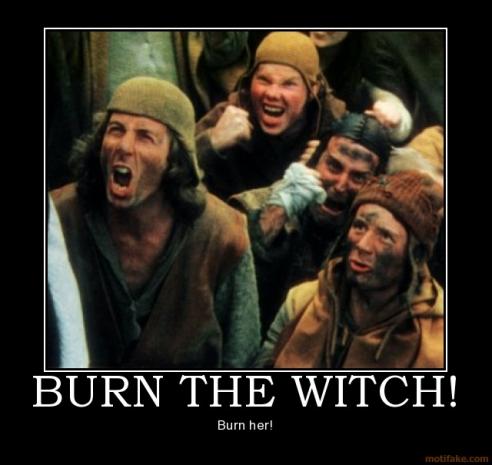
This chapter concludes with a short illustration by Lewis to those who would look at history and claim that they see very different Moral Laws at work, thus proving there is no one Law of Human Nature claiming our allegiance. Lewis uses the historical example of the burning of witches to prove his point. Some might say "Three hundred years ago people ... were putting witches to death. Was that what you call the Rule of Human Nature?" (14). Lewis's response follows here, and it would be good for us to take it to heart for those times when we meet skeptics who would claim the Moral Law is variable. Plus, it's super pithy and I can't resist a good quote.
Surely the reason we do not execute witches is that we do not believe there are such things. If we did-if we really thought that there were people going about who had sold themselves to the devil and were ... using [their] powers to kill their neighbors-surely we would all agree that if anyone deserved the death penalty, then these filthy quislings did? There is no difference of moral principle here: the difference is simply about matter of fact. It may be a great advance in knowledge not to believe in witches: there is no moral advance in not executing them when you do not think they are there. You would not call a man humane for ceasing to set mousetraps if he did so because he believed there were no mice in the house. (14-15)

Monday, January 14, 2013

First Signpost - The Law of Human Nature

Alternatively, Lewis could catch himself an alligator. That IS a pretty big rope he is usingThey say (whoever "they" are, and boy are "they" busy) that the proper way to give a presentation is to tell your audience up front what they are going to be getting from you. Lewis wastes no time telling us what he wants to get across with the title of the first portion of the book: "Right and wrong as a clue to the meaning of the universe." If I didn't know who I was going to be reading, I might think the author possesses a wee bit of hubris. As it is, let's give Lewis a little rope and see if he manages to rope himself a universe-sized steer, or if he hangs himself. I don't want to give away the ending this close to the beginning, but I'm betting he ropes that bull.

The first town we'll visit in our journey is one we should all be familiar with: Human Nature. Lewis wisely begins with a proposition none of us could honestly disagree with: we all think there are rules that others should follow (even if we tend to let ourselves off the hook most of the time). He illustrates this by picturing two people arguing. They might say "hey, I was here first" or "I did my part, now you do yours" or even "come on, you promised." Lewis points out that the speaker isn't just saying that the other guy's behavior displeases him, but he seems to be "appealing to some kind of standard of behavior which he expects the other man to know about" (3). And notice that the other guy doesn't usually respond "since when does being first matter" or "that's not how it works" or "I don't keep promises." Because, if the second guy did respond that way, we'd all call him a jerk and chastise him for not playing by the same rules the rest of us do. And by calling that second guy a jerk, we recognize that there is some sort of "rule of fair play" (4) that we're all supposed to agree on. To use an illustration that is likely to appeal to football fans, we can call a penalty on a linebacker because there is some sort of agreement about what the rules are for tackling quarterbacks (for the record: they're far too lenient. Get those pretty uniforms dirty, I say).

Lewis points out that we used to call this "rule of fair play" the "Law of Nature," not in the sense of a law like gravity or planetary motion or thermodynamics, but more like a "Law of Human Nature." The difference is that when you drop your iPhone, it has no choice but to fall to the ground and inevitably get some horrible scratches on its shiny case; you and I, however, can choose to disobey the set of rules that uniquely applies to us.

So the first question before us is this: is this "Law of (Human) Nature" universal, or peculiar to a few of us? Lewis tackles this question head-on with an illustration that was calculated to challenge his audience. Rather than referring to the Nazis as he did, I'll reproduce his question here with a little updating for modern readers:
What is the sense in saying the enemy were in the wrong unless Right is a real thing which the [terrorists] at bottom knew as well as we did and ought to have practiced? If they had had no notion of what we mean by right, then, though we might have still had to fight them, we could no more have blamed them for that than for the color of their hair. (5)
Or in the words of everyone's favorite Welsh accented King Arthur: "Either what we hold to be right and good and true IS right and good and true, for all mankind under God, or we're just another robber tribe."

Lewis anticipates that some of his audience might have an objection. And if his audience did, I know the world of today would object to this sort of "self-righteous Moralism." He points out that some might  say that different civilizations in different periods of time define Right and Wrong differently. There is some truth in this, but these past peoples don't really have all that radically different a definition of morality. Let me ask this imaginary objector the same question Lewis does: what would an entirely different morality mean? That is, what would it mean if some group in the past had a completely different morality from us? That would mean they valued running away from a battle, or applauded abandoning your family, or admired those who were abjectly selfish. Cowardice better than courage? Irresponsibility an improvement on reliability? Hard to imagine, huh?

And while I'm burning down some strawmen, let me ask you this, Mr. Imaginary Objector: you say you don't believe there is any real, universal, morally binding law of Right and Wrong. Good, I suppose you won't object then if I take your car for a drive and don't bring it back. I could use a new car, and I thank you for your generosity.

On a more serious note, take the example Lewis does of a nation that claims to not believe in treaties (Iran springs to mind as a great example). "Treaties don't matter," say the rulers of this country, but the very next moment we find them saying that they are free to break Treaty ABC because it's not a fair treaty (6). If treaties don't matter, if Right and Wrong are just words, what does it mean for a treaty to be fair or unfair? Doesn't this nation (as well as our Imaginary Objector who would really like to keep the keys to his BMW) reveal that there really is some standard that we all are beholden to?

I'll end today's blog before it gets longer than the section it is supposed to be summarizing, but I want to leave you with one more quote from Lewis:
[W]e are forced to believe in a real Right and Wrong. People may be sometimes mistaken about them, just as people sometimes get their sums wrong; but they are not a matter of mere taste and opinion any more than the multiplication table....None of us are really keeping the Law of Nature...I am not preaching...I am only trying to call attention to a fact; the fact that this year, or this month, or, more likely, this very day, we have failed to practice ourselves the kind of behavior we expect from other people. (7-8)
So let us take away two ideas: everyone, everywhere has this odd notion that there is some sort of Law that we all ought to obey. And, perhaps more importantly, we break that Law. A lot.


Next time, we look at some more detailed objections to this "Law of Nature." Until then, ponder those two ideas, and see if they ring true to you.

Sunday, January 13, 2013

Still Beginning the Journey

Before we actually hit the road with Lewis, I thought it might be a good idea to take the advice of another English writer and "begin at the beginning." The edition of Mere Christianity that I will be using for this trip is the HarperCollins 2001 edition. All my citations will be from this text, so if you're following along in another version, I'm sorry the page numbers won't match. I won't always cite every quote I make, especially when I make several in a row that are from the same page. I'll try to cite the first quote from each page, so you can follow along. Mere Christianity begins with a preface from Lewis himself, stating the history of the book, his purpose in writing it, and a hint to the reader of how he hopes his thoughts will be applied. After reading it through again, I think it might be a good idea to hit on a few of Lewis's points before we get into Chapter 1.

n discussing the history of the book, Lewis mentions that he originally presented the material as a series of radio presentations. They originally aired on BBC in 1942-1944. I am amazed at God's provision that in war-torn Britain, there was a hunger to hear about His grace and He provided just the man to deliver it. The edition of the book that I have is slightly edited from those original broadcasts, but what we will be reading is not substantially different from what those huddled in their homes during times of war and unrest.

ewis's purpose in writing is made very evident over the ensuing pages. He has no desire to convert anyone to his own position (a not especially high nor especially low layman in the Church of England, if anyone's keeping score), but merely to "explain and defend the belief that has been common to nearly all Christians at all times" (VIII). Lewis wishes to avoid any debates on high theology or church history, because he doesn't feel qualified but even more because he realizes that such issues only keep those outside Christianity, outside. I agree completely with Lewis here. While I love a lively debate, intramural squabbles between Christians hardly make us attractive to those who do not know Christ. In other blog posts, I might get into issues of "higher theology", but for now, we will confine ourselves to the same avenues Lewis does. He quotes the 17th century pastor Richard Baxter to narrow his scope to that which Baxter called "mere Christianity." Clearly Lewis does not mean to reduce the gospel to a "mere" anything, but rather he wants just to focus on those central ideas that unite us as Christians.

Before we go further, I would like to follow the rabbit-trail Lewis chases. I will give a few quotes, interspersed with some commentary.
Far deeper objections may be felt - and have been expressed - against my use of the word Christian to mean one who accepts the common doctrines of Christianity. People ask: "Who are you, to lay down who is, and who is not a Christian?" or "May not many a man who cannot believe these doctrines be far more truly a Christian, far closer to the spirit of Christ, than some who do?" (XII-XIII)
Let us not dismiss these theoretical objectors too quickly. Lewis rightly observes that "this objection is in one sense very right, very charitable, very spiritual, very sensitive."(XIII) However, his very next sentence puts the objectors in their place: "It has every available quality except that of being useful." Heh. Well. Not much to say to that, huh? I think Lewis touches on a good point though: words have meanings, for a good reason. He discusses how the word gentleman use to refer merely to a person who had a coat of arms and some land. It was not a compliment, merely a statement of fact. Over the years, the definition of gentleman expanded to include an idea of "true gentlemanliness" that was deeper, more spiritual. As such, to call someone a gentleman no longer conveys information about that man (i.e. owner of some land), but now it tells you what the speaker thinks about the man. We already have words to tell you if we think someone is honorable or brave or kind or chivalrous, so co-opting the word gentleman just robs us of a word that used to have a unique, historical meaning. In the same way, if we allow the word Christian to be deepened and broadened and massaged to mean those who act kindly or selflessly or who are "nice people", we "will never be able to apply it to anyone" (XIV). To do so puts us in the place of judging hearts, and we "are indeed forbidden to judge...that any man is, or is not, a Christian in this refined sense." If, however, we restrict ourselves to the historical sense of the word, we can join Luke and use the word to mean disciples of Christ, those who accept the teachings of "mere Christianity."

inally, Lewis ends his preface with a word-painting. He asks us to imagine ourselves standing in the great hall of a house, with many doors leading off to other rooms. "Mere" Christianity is that hall, where all who are disciples of Christ enter. Eventually we will find ourselves opening one door or another and entering the rooms of Congregationalism or Presbyterianism or whatever. Lewis's purpose is merely to get us from outside the house into the hall, which door we enter is up to us. Given that many of the readers of this blog are likely to have opened and walked through different doors, I conclude this post with his plea to his readers.
You must keep on praying for light: and, of course, even in the hall, you must begin trying to obey the rules which are common to the whole house. And above all, you must be asking which door is the true one; not which pleases you best by its paint and panelling...When you have reached your own room, be kind to those who have chosen different doors and to those who are still in the hall. If they are wrong they need your prayers all the more, and if they are your enemies, then you are under orders to pray for them. That is one of the rules common to the whole house." (XVI)

Monday, January 7, 2013

Beginning a Journey

About six months ago, my wife told me I should start a blog. Now, while I enjoy reading blogs, I'm not necessarily the type to enjoy writing one. When I asked her what I should blog about, she suggested that I blog through some C.S. Lewis, ala Julia and Julia. Lewis just so happens to be my favorite author, and he's written more books than I could ever possibly work my way through, so I said I'd think about it.

Fast forward to now. It's a new year so I figured it would be a good time to start reading some more profitable literature than I normally enjoy (currently the Dresden Files series, if anyone is interested).

I'm not about to pretend that I'm qualified to analyze C.S. Lewis. The man knew more about English literature than I can even fathom, and he's widely recognized as one of the most influential authors and Christian apologists of the 20th century. Thus, my goal is not to discover something new in Lewis's writings, nor to come up with some grand commentary that would leave Jack himself astounded at my brilliance. No, my goal is simple: embark on a journey. Another book I'm currently reading points out that an epic journey is the foundation for pretty much all classic literature. So if you're willing, please join me on a journey through a few books that have delighted Christians (and non-Christians, too) for decades.

We will begin our trek with Mere Christianity. It's a wonderful book; a 2006 ChristianityToday list of books that have most influenced evangelicals ranked it at #3. For those of you who may be unfamiliar with it,  Lewis's masterpiece of Christian apologetics makes a straightforward 'argument from morality' to insist that there must be a God and that He must be like the God we find in the teachings of Christianity. Lewis then takes a journey of his own through the Christian virtues, insisting that they are the natural consequence of accepting the God of Christianity. My plan is to cover a chapter or so a week, discussing the themes that jump out at me and trying to help apply some of the timeless truths Lewis explores to our time-bound lives. I hope you will add your comments and fill in the parts that I miss, and correct me when I inevitably get something completely wrong. Next week, we'll dive headfirst into the deep waters of my favorite book Lewis ever wrote, and the first "grown-up" book of his that I ever read.